The New Authority Behind the Bar: How Wine Directors Came to Command America's Most Prestigious Rooms
For much of the past two decades, the cocktail renaissance defined the aspirational grammar of American nightlife. The master mixologist occupied a position of near-mythological authority—part chemist, part historian, part performer. Guests leaned forward as their drinks were constructed with theatrical deliberateness. Menus read like scholarly monographs. The bartender was the room's intellectual center, and the lounge was, in many respects, built around that centrality.
That architecture has not collapsed. But it has been complicated, and in the most prestigious establishments across the country, it has been quietly renegotiated. The figure now commanding the deepest deference in America's finest lounge environments is increasingly not the man or woman behind the bar—it is the wine director standing beside it.
The Credentials That Changed the Conversation
To understand this shift, one must first appreciate the institutional weight that serious wine credentials now carry in American professional culture. The Court of Master Sommeliers, with its notoriously rigorous examination process, has produced a class of professionals whose expertise is both genuinely formidable and conspicuously legible. When a lounge lists a Master Sommelier among its staff, it is making a statement that affluent guests have learned to decode with precision.
The equivalent signal in the cocktail world—while real and respected—has never achieved the same degree of institutional authority. Cocktail competitions, certifications, and industry recognition matter enormously within the trade. But to the guest sitting at a high-top in a Manhattan lounge, the phrase 'our wine director holds the Master Sommelier diploma' carries a weight that few bartending credentials can match in the same room.
This is not a commentary on the relative difficulty of the disciplines. It is an observation about how credentials function as social currency, and how that currency is spent in environments where status is communicated through subtle, layered signals.
Wine as a Vehicle for Cultural Capital
The ascent of the wine director also reflects a broader evolution in how affluent Americans demonstrate cultural sophistication. The cocktail renaissance democratized a form of connoisseurship that had previously been the province of specialists. Today, a working knowledge of amaro families, a preference for mezcal over tequila, and an ability to name one's preferred Scotch region are table stakes at a certain professional level. They no longer distinguish; they qualify.
Wine, by contrast, retains a complexity that resists easy mastery. The geography of Burgundy alone—its premier crus, its village appellations, its producer hierarchies—represents years of dedicated study. The vintages of Barolo, the distinctions between Napa Valley sub-AVAs, the emerging regions of the American Pacific Northwest: each domain is a discipline unto itself. For guests who have moved beyond cocktail literacy and are seeking a new frontier of connoisseurship, wine offers an almost inexhaustible depth.
The most sophisticated lounges have recognized this appetite and responded accordingly. Wine programs that once occupied a polite corner of the menu now anchor the entire beverage identity of the room. Lists run to dozens of pages. By-the-glass selections are curated with the same intentionality that cocktail menus once were. And the wine director who assembled that selection has become, in effect, the room's presiding intellectual authority.
The Lounge as a New Theater for Wine Service
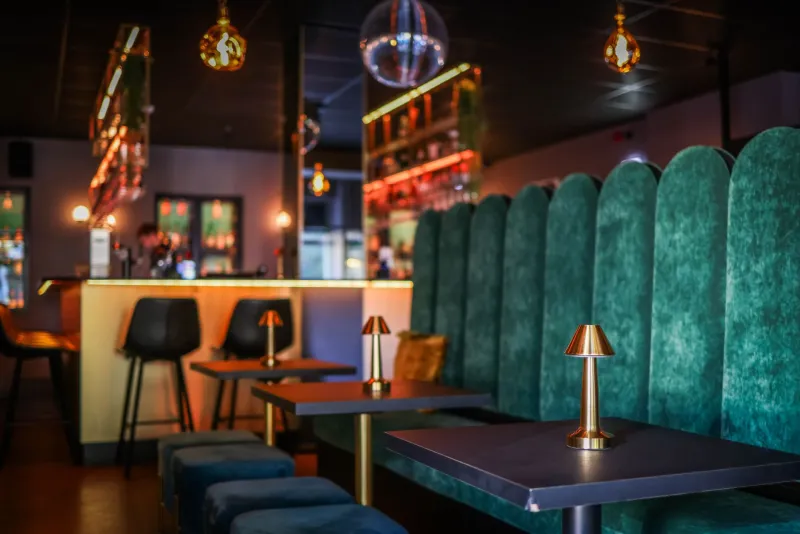
Perhaps the most visible expression of this shift is the physical integration of serious wine service into lounge environments that were once the exclusive domain of spirits. Coravin systems now appear on bar carts, allowing rare bottles to be poured by the glass without compromising the remaining wine. Temperature-controlled wine walls have become architectural features rather than afterthoughts. Glassware programs—once a preoccupation of fine dining rooms—have migrated into the lounge, where the decision to serve a particular Burgundy in a specific Zalto bowl is understood as a statement of intent.
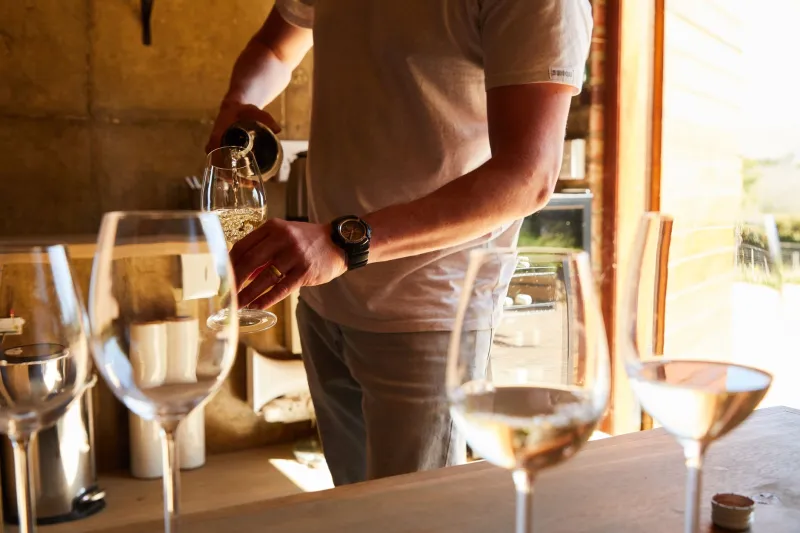
The service choreography has evolved accordingly. In the most refined establishments, the wine director's table visit carries a formality and duration that the cocktail presentation rarely achieves. There is a ritual quality to the uncorking, the pour, the assessment, the conversation about the producer's philosophy and the vintage's particular character. It slows the evening in a way that feels deliberate—even luxurious—rather than inefficient.
For guests who have spent years being dazzled by cocktail theater, this different kind of ceremony offers something genuinely new: a form of expertise that invites dialogue rather than observation.
The Bartender's Response
It would be a mischaracterization to suggest that America's finest mixologists have ceded ground without a response. Many of the country's most celebrated bar programs have adapted by deepening their engagement with wine-adjacent categories—vermouth, sherry, sake, and other fermented beverages whose complexity bridges the two worlds. Others have pursued their own credentialing, with spirits education programs gaining increasing institutional recognition.
There is also a growing cohort of beverage directors who refuse the distinction entirely—professionals whose programs treat cocktails, wine, spirits, and fermented beverages as a unified discipline, and whose authority derives from the breadth of that vision rather than its depth in any single category.
But in the rooms where the question of hierarchy is most pointed—where a guest arrives seeking to be guided through an evening of genuine discovery—it is increasingly the wine director who sets the tone.
What This Means for the Future of the Lounge
The elevation of wine expertise within the lounge environment is not merely a trend in professional staffing. It represents a recalibration of what America's most discerning guests are seeking when they enter a room of this caliber. They are not looking to be impressed by technical virtuosity, though they will appreciate it when they encounter it. They are looking to be educated—gently, unhurriedly, and without condescension—in a domain that rewards sustained attention.
The lounge that understands this is the lounge that will define the next chapter of American nightlife sophistication. And at its center, commanding the quiet authority that the room demands, will be a figure who speaks the language of terroir as fluently as any sommelier in the finest dining rooms in the country.