Designed for Discourse: The Quiet Revolution of the Conversational Lounge
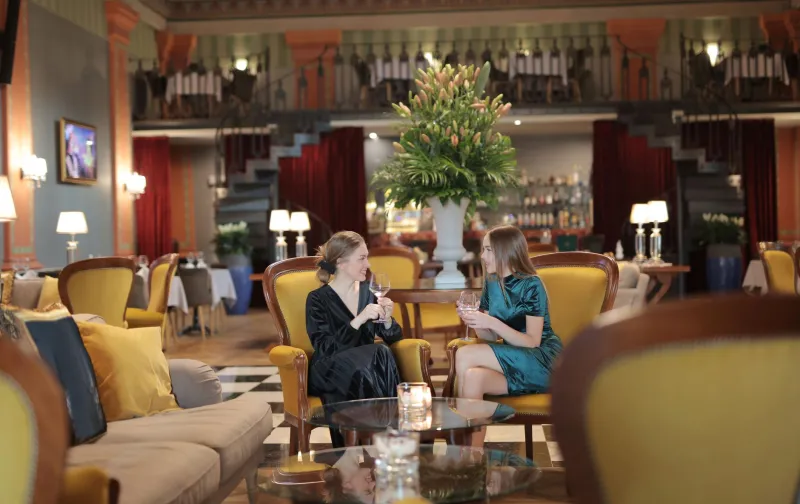
The most valuable thing a great lounge can offer is increasingly difficult to find in most of them: the conditions under which two people can actually hear each other.
This is not a small complaint. In an era defined by ambient noise — the relentless digital chatter of notifications, the open-plan cacophony of modern offices, the performative volume of entertainment venues mistaken for social ones — the ability to conduct a genuine conversation has become a form of luxury. And a growing number of America's most thoughtful lounge proprietors have identified this need and built their rooms around it.
The Problem with Entertainment
The conventional nightlife venue is designed, above all, to stimulate. Live music, projection surfaces, curated playlists at volumes that preclude comfortable speech, lighting schemes calibrated for photography rather than intimacy — these are the standard tools of an industry that has conflated activity with experience.
For a certain kind of professional, the result is exhausting. The evening that was intended as an opportunity for connection becomes instead a series of shouted exchanges, leaned-in repetitions, and ultimately abandoned conversations. The drinks are consumed. The check is paid. The connection, such as it was, remains largely unmade.
The conversational lounge begins from a different premise: that the drink is a vehicle for the conversation, not the reverse. That the room exists to serve the relationship between the people in it, and that every design decision should be evaluated against that standard.
The Architecture of Listening
The physical characteristics of a room designed for conversation are specific and, once understood, immediately recognizable.
Acoustics are primary. The finest conversational lounges in New York, Washington D.C., and San Francisco have invested substantially in sound-absorbing materials — upholstered walls, heavy curtain treatments, deep-pile rugs, coffered ceilings — that prevent sound from traveling beyond the table at which it originates. The result is a room that feels, paradoxically, more intimate as it fills. Each conversation remains private even as the space becomes populated.
Seating configurations follow a similar logic. Banquettes positioned perpendicular to walls, chairs angled toward rather than beside their companions, table heights calibrated to encourage leaning in rather than sitting back — these are the spatial decisions of a proprietor who has thought carefully about what proximity does to the quality of human exchange.
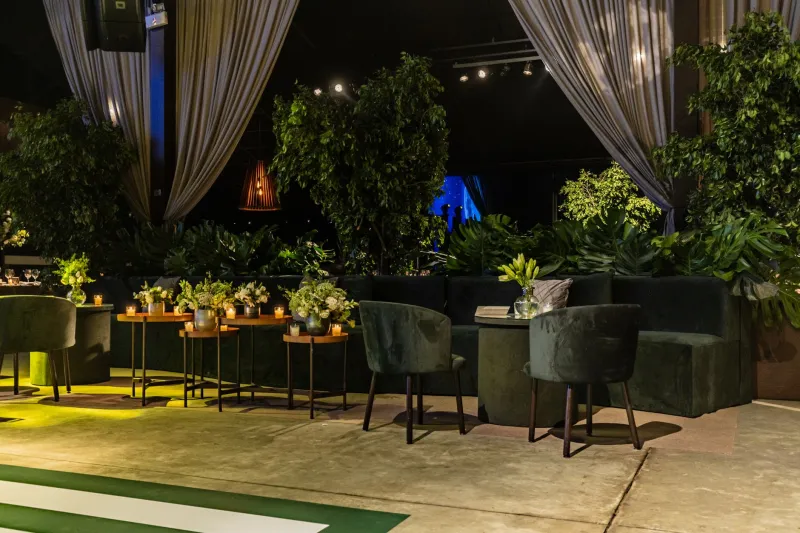
Lighting, too, is deployed with intention. The amber warmth of a properly lit conversational lounge serves not merely aesthetic purposes but psychological ones. Studies in environmental psychology have consistently demonstrated that warmer, lower-intensity lighting produces more relaxed, open, and candid social behavior. The guest who might be guarded under fluorescence becomes, under candlelight or its considered approximation, more genuinely present.
What Is Deliberately Absent
Perhaps more revealing than what these rooms contain is what they exclude.
No live music. The decision to forgo live performance is not an admission of ambition but an expression of it — an acknowledgment that the most compelling performance in the room should be the conversation at the table. Several of the most respected lounges operating in this vein enforce a strict policy against any amplified audio exceeding a carefully calibrated ambient threshold, typically somewhere between forty and fifty decibels: audible, but never dominant.
No screens. The television above the bar — that ubiquitous fixture of the American drinking establishment — is absent from the conversational lounge by design. Its presence, even when muted, fragments attention and provides an exit from the discomfort that sometimes precedes genuine connection. Its absence requires guests to remain with each other.
No performative décor. The minimalism characteristic of these spaces is not austerity for its own sake. It is the removal of visual noise — the elimination of surfaces that compete with the people occupying them. A room with too much to look at is a room that discourages looking at the person across the table.
The Professional's Return to the Physical
The clientele drawn to conversational lounges tends to share certain characteristics. They are, broadly speaking, professionals for whom the quality of their thinking and the depth of their relationships constitute professional assets. Lawyers, executives, investors, editors, academics — people whose work depends on their ability to listen carefully, articulate precisely, and build trust incrementally.
For this cohort, the conversational lounge offers something that no digital medium can replicate: the full-bandwidth human encounter. Eye contact sustained across a properly lit table. The micro-expressions that reveal what words conceal. The silence between sentences that signals genuine reflection rather than latency.
In this context, the lounge becomes not merely a social venue but a professional one — a space where the relationships that matter most are built and maintained with the care they deserve.
The Counter-Programming of Quiet
There is something quietly radical about a room that refuses to compete for attention. In a culture that rewards stimulation and equates volume with vitality, the conversational lounge makes a different argument: that the most sophisticated evening is one in which nothing remarkable happens, and everything essential does.
The conversation that changes the direction of a career. The friendship deepened by an uninterrupted hour. The understanding reached across a table that no email chain could have produced. These are the outcomes that the conversational lounge is designed, in every particular, to make possible.
For the professional who has grown weary of venues that promise connection and deliver spectacle, this is not a modest offering. It is, in fact, the most ambitious thing a room can aspire to: the conditions under which people become, briefly, fully present to one another.
In the current moment, that qualifies as a luxury.